
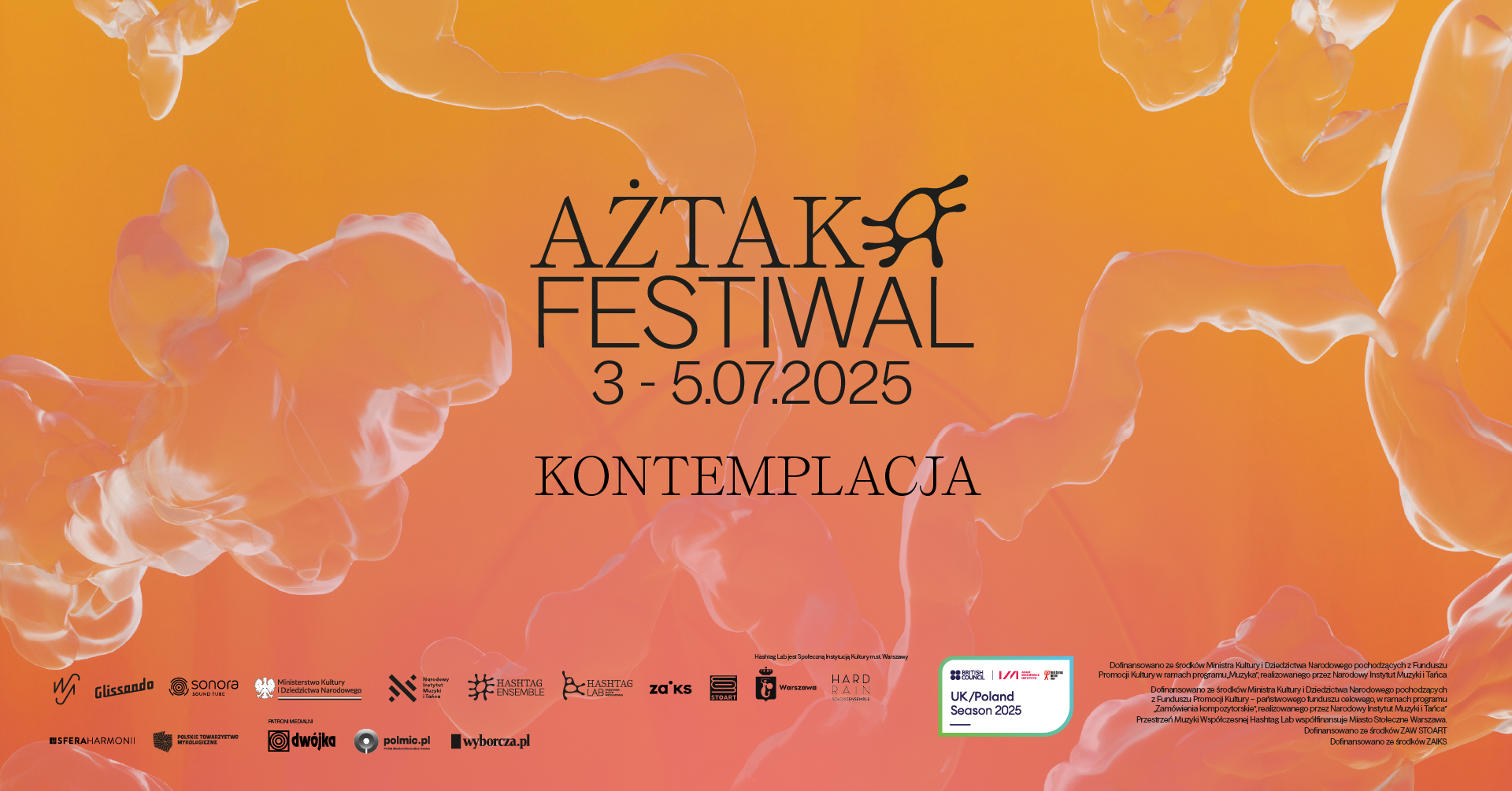
AżTak Festiwal Dzień 1: SEN
We will begin the festival by immersing ourselves in sound, thanks to a remarkable instrument: Sonora Sound Tube. The main part of the evening will be filled with music by the festival’s composer-in-residence — Wojtek Blecharz — in two distinct, spatial guises.
Program:
18:00
B383, Barska 38 m.3
Sonora Sound Tube opening
Reserve your free ticket
Performers:Katarzyna Suberlak Sonora Sound TubeMarta Grzywacz voiceMarta Piórkowska violinPaweł Janas K‑droneWojciech Błażejczyk zithers
Bartosz Paradowski viola
15:00–18:00
B383, Barska 38 m.3
Sonora Sound Tube
Katarzyna Suberlak — Sonora Sound Tube
Book your free massage
Exhibition of works by Magdalena Lenartowicz.
19:00
Hashtag Lab, Barska 29
Wojciech Blecharz Axis.B**world premiere
Masashi Yamamoto (Japan)
20:00
Wojciech Blecharz Field 6. Dream Notes
Hashtag Ensemble:Kamil Staniczek violinAleksandra Demowska-Madejska violaMichał Bień cello*Mateusz Loska double bassPaweł Janas accordion, K‑droneWojciech Błażejczyk electric guitarAnia Karpowicz bass fluteŁukasz Nędza saxophone***Akademia PRO**guest
The concert will be preceded by a conversation with the creators.
Reserve your free ticket
Production:
Sound engineering: Kosma StanderaProduction: Aleksandra Demowska-MadejskaVisual identity: Aleksandra Ołdak
About the programme:
The theme of the first day of the festival is the concept of the dream. The physicality of sound, musical exploration of space and movement, will create illusory planes of sound in which each listener will perceive and feel something different. Shifts of role and unusual arrangements will build a phantasmagorical space for new musical experiences.
From the very start, listeners will be able to enter a state of relaxation — the festival will open with short sound massages using the Sonora Sound Tube, an innovative instrument designed for sound therapy. The bass sounds produced by the device will induce a state of relaxation and quietude in the patient-listener. Bookings for massages are open for all three days of the festival. The Sonora can also be heard on the first evening as part of an improvised concert in the B383 space.
Further events will centre on the work of the composer-in-residence, Wojtek Blecharz. On the first day we will hear as many as two of his compositions — Axis.B (2025) for double bass and 7 wireless speakers, and Field 6 (2020) for eight instruments. The first is a continuation of Blecharz’s earlier work from 2016, Axis.A, for cello, rhythm generators, and analogue synthesisers. Axis.B was created in collaboration with Japanese double bassist Masashi Yamamoto during the composer’s artistic residency in Tokyo in May 2025. Both Axis pieces complement each other. Whereas Axis.A is a sonic “vertical axis,” performed in a vertical space consisting of a minimum of seven levels, Axis.B is a “horizontal axis” divided into seven sections, each of which must be performed in a different part of the concert hall while maintaining an arrangement that forms a straight line. The use of wireless speakers is intended to compose the space in the manner of a sonic memory map, based on the speculative theory that no sound in a space ever completely fades away. Like a dream, the acoustic waves generated are meant to persist even after the sound source has left the room. The double bass, slowly traversing the concert hall, leaves a sonic trace behind it, also recalling some of the motifs present in Axis.A, becoming the binding element of all the musical threads.
The result of Blecharz’s search for a new type of narrative is the composition Field 6 (2020–21), written specially for Hashtag Ensemble. The work, intended to be performed by eight musicians, is an invitation for the performers to increase the role of shared improvisation, building the piece by responding in real time to the parts played by the other musicians, and through deep listening to the individual elements of the composition. To better understand this idea the composer includes an excerpt from the scenario from the fourth movement of the “Field” cycle, “Field 4. Nexus”: “Each solo contains many fermatas, which allow for listening to and contemplating the playing of other musicians, as well as for finding the right moment to return to ensemble playing. Although each solo is in a sense independent, they all share the same basic tempo. The musical narrative should be shaped as a dialogue between soloists, based on action-reaction, call-and-response, and a coherent flow of sonic energy among all the musicians. Always react to other musicians by starting a new phrase in response to what you hear in the space: continue, repeat, join in, break the narrative, conclude, create echoes or contrasts — all in order to create a deep musical understanding among the solo voices.”
The title Field becomes a marker for the sonic dramaturgy: the musicians participate in creating a kind of “sonic field,” a terrain in which sound is present and moves through space along many trajectories. Each of the eight works entitled “Field” has a subtitle, with the exception of the sixth field… As the composer himself says: “To this day I do not know where this music came to me from, where it ‘heard itself’ into being, where its sometimes dark character and sonic, esoteric spleen came from. Is it a requiem written in advance for a friend, a sonic coincidence (synchronicity), notes from a dream/vision, or another lesson from Professor Bad Trip…?”
The Sonic Field cycle consists of:
FIELD 1–3. Feeling Feelings for violin, contrabass clarinet and percussion (2018)
FIELD 4. Nexus for 9 performers (koto, shamisen, cello, double bass, shakuhachi, daegeum, viola, violin, gongs) (2018)
FIELD 5. Aura for 1 listener, 1 performer and 7 wireless speakers (2019)
FIELD 6. for 8 performers (bass flute, saxophone, violin, viola, cello, double bass, k‑drone/accordion and electric bass)
FIELD 7. Delta for 10 performers (bass flute, clarinet, bassoon, saxophone, trumpet, violin, viola, cello, percussion and keyboards) (2021)
FIELD 8. Elixir for orchestra in 10 groups (2022–2023)
In all the activities offered to audiences on this day, the organisers together with the composers invite the listener to surrender to the music in the manner of deeply following dream visions, which will surely take each person on a unique, individual sonic journey.
text: Natalia Górecka
***
The Hashtag Lab Contemporary Music Space is co-funded by the City of Warsaw.
Co-funded by the Minister of Culture and National Heritage from the Culture Promotion Fund under the “Music” programme, implemented by the National Institute of Music and Dance.
Co-funded by the Minister of Culture and National Heritage from the Culture Promotion Fund — a state-purpose fund — under the “Compositional Commissions” programme, implemented by the National Institute of Music and Dance.
The festival was created thanks to the collaboration and support of: B383 Art Space, Sonora Sound Tube, Adam Mickiewicz Institute, Glissando, ZAiKS, Stoart, Hard Rain SoloistEnsemble, Warsaw Theatre Association, Polish Mycological Society, British Council.
Media patrons:
Dwójka Polskie Radio
Gazeta Wyborcza
POLMIC.PL
Tickets
Free Entry