
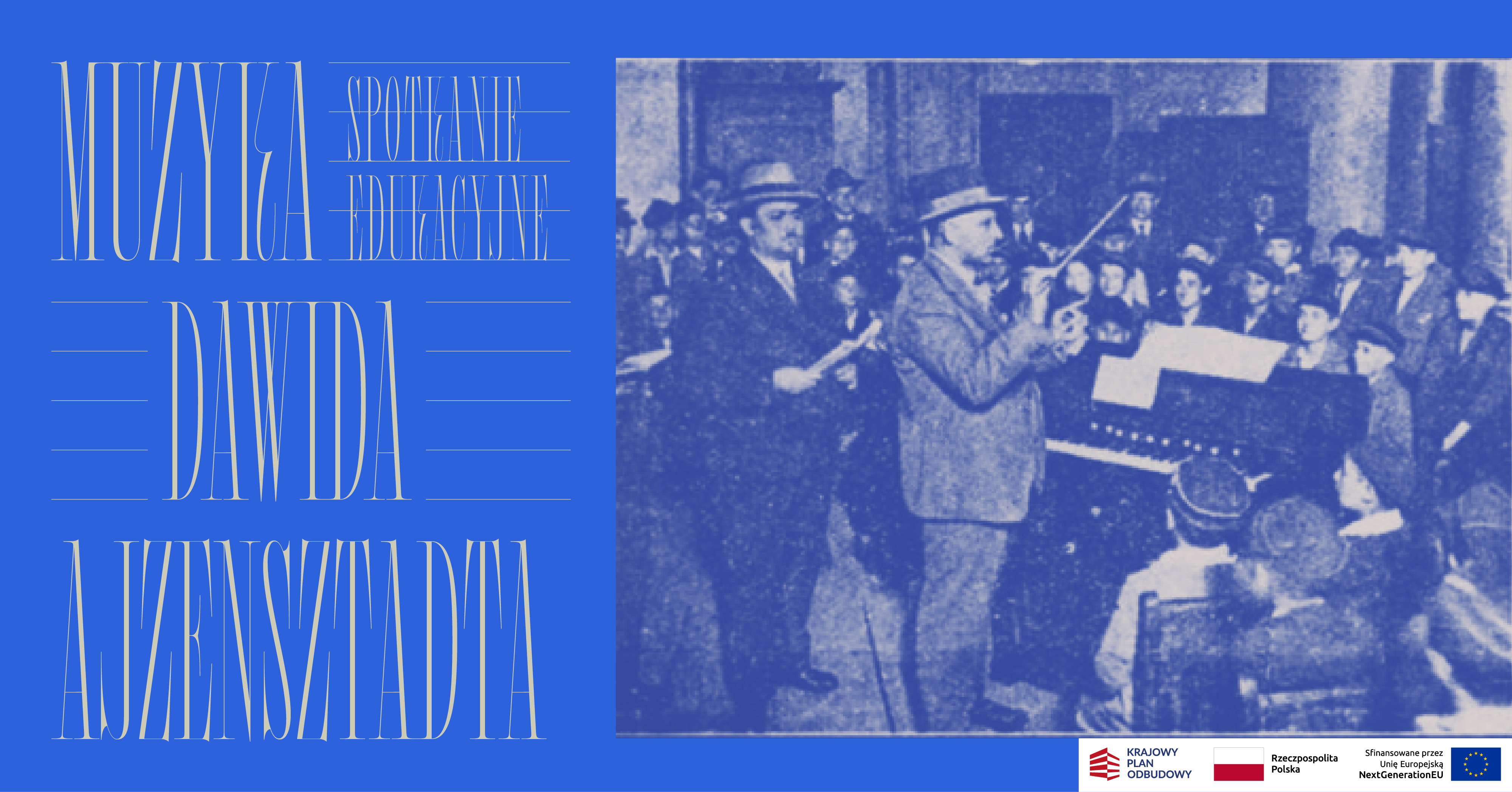
Żydowska muzyka w Polsce międzywojennej – Dawid Ajzensztadt i jego Warszawa
We invite you to a meeting dedicated to the music of Dawid Ajzensztadt (1890–1942), choirmaster of the Great Synagogue on Tłomackie Street. The meeting will be attended by: Dr Jakub Stefek, Dr hab. Maria Sławek and Lilianna Krych. During the event, music by Dawid Ajzensztadt will be presented by: tenor Wojciech Parchem, organist Jakub Stefek, conductor Lilianna Krych and the vocal ensemble Match Match Ensemble — the artists behind the album
Music of David Eisenstadt, the first album in the history of sound recording to feature music by
the great champion of Jewish music, which will be released on 17 November.
Reading any book about pre-war Warsaw’s musical life, or about the Jewish culture of the capital, one is likely to encounter a longer or shorter mention of Dawid Ajzensztadt. He is described everywhere as the greatest, the most outstanding, the most brilliant, and above all the most dedicated musician and composer.
Dawid Ajzensztadt was born in 1890 in Nasielsk, and after a period of study, travel and various short-term positions he settled permanently in Warsaw, where from 1921 he served as choir director of the Great Synagogue on Tłomackie Street. During the occupation he became
one of the most active musicians in the Warsaw Ghetto. He founded a symphony orchestra and conducted choirs. He accompanied on piano his daughter — Marysia, whose miraculous voice earned her the title of “Nightingale of the Ghetto” from her listeners. In 1942 Dawid Ajzensztadt was
deported to Treblinka and murdered there.
How did the artists come across the music of Dawid Ajzensztadt, long believed to be lost? What exactly was found? Why did some of the scores come into their hands for the first time after 80 years since they were written? What does the music of
Dawid Ajzensztadt tell us, and what can we learn from it?
Answers to these and other questions will be presented by Jakub Stefek and Lilianna Krych, who can be heard on the album Music of David Eisenstadt — the first album in the history of sound recording to feature the music of this great champion of Jewish music. They will be joined in the discussion by violinist Maria Sławek, a specialist in the history of Jewish music who teaches her own course on The History of Jewish Music within the Postgraduate Polish–Jewish Studies Programme at the Institute of Literary Research of the Polish Academy of Sciences.
To close the event, tenor Wojciech Parchem, organist Jakub Stefek and the vocal ensemble Match Match Ensemble under the direction of Lilianna Krych will give the world premiere of three works from the album, which will be released on 17 November on vinyl.
Performers:
Jakub Stefek harmonium
Wojciech Parchem tenor
Lilianna Krych conductor
Match Match Ensemble — choir consisting of:
Sopranos
Aleksandra Drogosz-Szymańska
Konstancja Molewska
Adrianna Żołnierczuk-Malec
Maria Złotek
Altos
Małgorzata Bartkowska
Ewa Kijewska
Marzena Lewandowska
Marta Schnura
Tenors
Andrzej Klepacki
Paweł Kowalewski
Jakub Prasał
Aleksander Słojewski
Basses
Michał Kijewski
Michał Malec
Project co-financed by the European Union from the Recovery and Resilience Facility under the National Recovery and Resilience Plan.
The album recording was made at the POLIN Museum of the History of Polish Jews in Warsaw in 2024.
The release of the album Music of David Eisenstadt was co-financed from the funds of the Minister of Culture and National Heritage drawn from the Culture Promotion Fund, within the programme “Muzyczny ślad”, implemented by the National Institute of Music and Dance.
The Hashtag Lab Contemporary Music Space is co-financed by the Capital City of Warsaw.
The media patron of the Hashtag Lab Contemporary Music Space is POLMIC.PL.
Tickets
Free Entry