
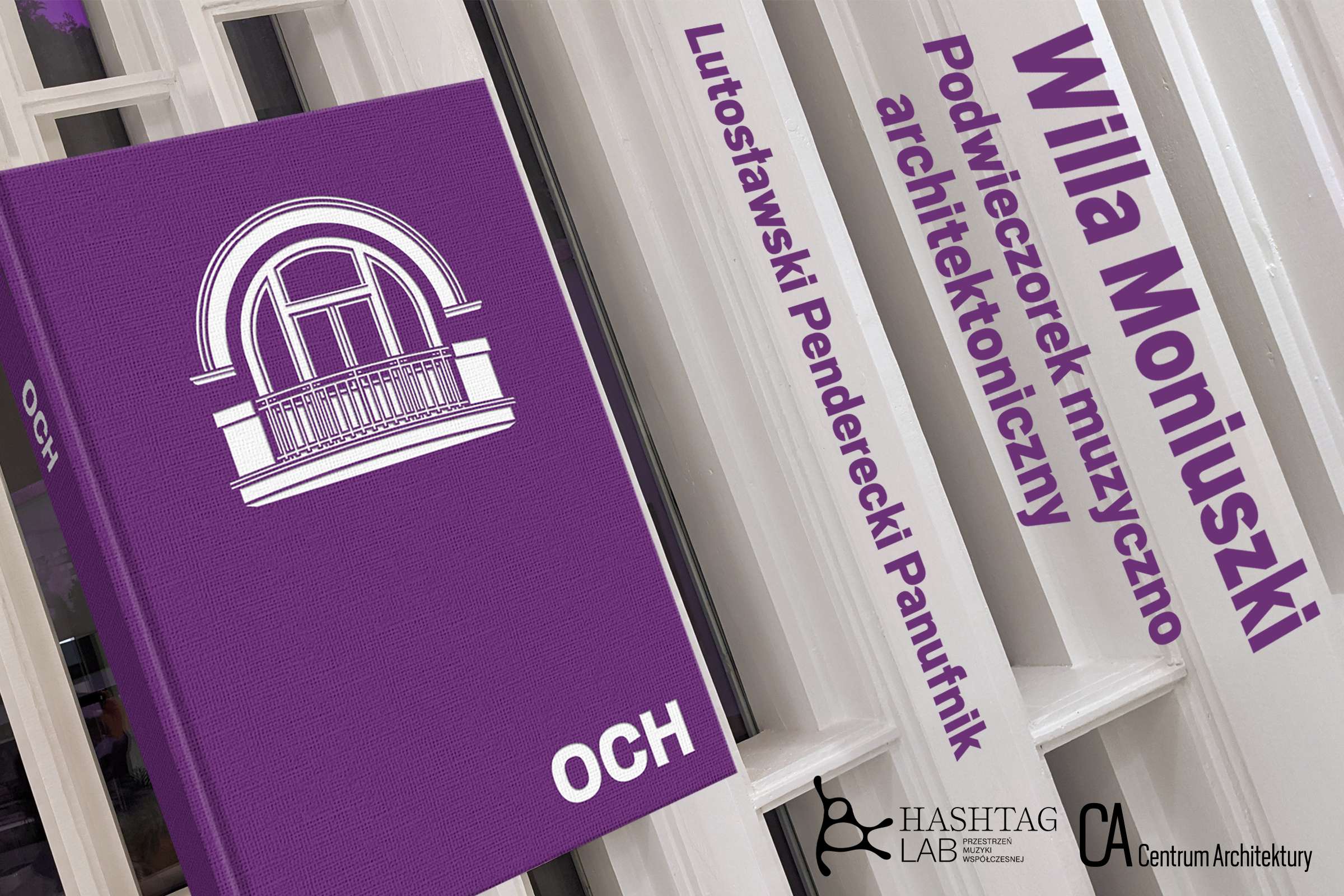
Willa Moniuszki. Podwieczorek muzyczno-architektoniczny
Hashtag Lab and the Architecture Centre Foundation invite you to a musical-architectural afternoon tea organized on the occasion of the reissue of the book OCH. Illustrated Atlas of Ochota Architecture.
As regular visitors will know, Hashtag Lab is a community cultural institution, a space for the practice of contemporary music. It is housed in a recently renovated modernist villa in Stara Ochota. For years its owner, Antoni Moniuszko, ran a cultural salon here, frequented by Warsaw intellectuals, including outstanding 20th-century composers such as Krzysztof Penderecki and Witold Lutosławski. And it is with music by those and other composers that we wish to celebrate this Sunday noon the reissue of the atlas, in which one of the Ochota objects described is the very villa of Antoni Moniuszko — a building unlike any other, astonishingly designed and still concealing secrets; described in the first edition of the atlas as “hidden behind a fence” and “falling into disrepair,” and in the reissue — as pulsating with musical life.
Conversation and a tour
Participants will include the authors of the atlas: Mateusz Bzówka and Ewelina Klećkowska.
Café, foyer conversations, book sales, autographs
Concert program:
Witold Lutosławski 6 melodii ludowych for string quartet (arr: Marcin Markowicz)Krzysztof Penderecki Trzy utwory w dawnym stylu Roxanna Panufnik Olivia for string quartet and voices
Performers:
Poldowski String Quartet:
Marta Piórkowska violinAgata Krystek violin Damian Kułakowski violaDominik Płociński cello*
*guest performer
Match Match Ensemble:
SopranosAleksandra Drogosz-SzymańskaKonstancja MolewskaMaria ZłotekAltosSmałgorzata BartkowskaMarzena LewandowskaMarta Schnura
Lilianna Krych conductor
Production:
Artistic concept and text: Marta Piórkowska, Agnieszka Rasmus-Zgorzelska, Lilianna Krychproduction: Marta Piórkowska, Agnieszka Rasmus-Zgorzelska, Lilianna Krychvisual identity: Peter Łyczkowskisound engineering: Kosma Standeraco-organization: Centrum ArchitekturyThe Hashtag Lab Contemporary Music Space is co-financed by the Capital City of Warsaw. The media patron of the Hashtag Lab Contemporary Music Space is POLMIC.PL.
Find out more about the artists and works:
Poldowski String Quartet — a string quartet founded by four lovers of chamber music: Marta Piórkowska (violin), Agata Krystek (violin), Damian Kułakowski (viola) and Mateusz Błaszczak (cello). The ensemble’s patron is Irene Poldowski, an unjustly forgotten composer, the youngest daughter of Henryk and Izabela Wieniawski.
Match Match Ensemble — a vocal ensemble engaged in explorations in the area of contemporary, early and operatic music and at the boundaries of the arts. Through its activity it influences the changing perception of classical music as a domain for the chosen few, for the understanding of which one must be superbly educated and sensitized.
The Atlases
The illustrated atlases of Warsaw architecture were conceived by graphic designer Magdalena Piwowar. We have been publishing them for eleven years. First came SAS, then ŻOL, MOK, OCH, POW, PRA, ŚRÓD PN and MUR. Atlas premieres are accompanied by original architectural walks, artistic-educational events and podcasts published on the podcast Radio Architektura website (www.radioarchitektura.pl). The publisher is Centrum Architektury (https://centrumarchitektury.org/).
About the works:
W. Lutosławski — 6 melodii ludowych
Zalotny; Ach, mój Jasieńko; Hej, od Krakowa jadę; Gaik; Gąsior; Rektor
The selected works come from the cycle of miniatures Melodie ludowe, originally composed for piano in 1945. They represent the earliest — folkloristic — period of Witold Lutosławski’s work. The material comes from various regions of Poland — Łowicz, Kraków, Podlasie, Sieradz, Kurpie, Mazury and Silesia. The composer, in his characteristic way, embeds tonal folk melodies in an atonal context. Although Melodie ludowe were originally intended for pedagogical purposes, they have become a permanent part of the performing canon and have inspired numerous arrangements and adaptations. The composer himself returned to them in his later work, orchestrating them for string orchestra and four violins. The author of the present arrangement for string quartet is violinist Marcin Markowicz.
K. Penderecki — 3 utwory w dawnym stylu
This short suite presents a lesser-known face of Krzysztof Penderecki. Few people know that this composer, known for his great concert works, occasionally wrote film music. Although he never wanted to immerse himself more deeply in this strand of creative work (and subsequently declined offers to write film soundtracks), these three miniatures show that the artistry and richness of his compositional craft allowed him to create excellent tonal, illustrative and stylized music as well. The suite-opening Aria comes from the 1968 documentary film Passacaglia na Kaplicę Zygmuntowską directed by Zbigniew Bochenek. The film tells the story of a jewel of Polish Renaissance architecture at Wawel Castle, and the work transports us through its style into the world of that era. The next 2 works are Minuets from the film Rękopis znaleziony w Saragossie by Wojciech Jerzy Has. This is a brief excerpt from the soundtrack, which was the only one composed entirely by Penderecki. The score of the Trzy utwory w dawnym stylu waited twenty-five years for publication, and the complete soundtrack was released on vinyl only in 2005.
R. Panufnik — Olivia
At your door, my lady,I would build a willow-twig cottage,And enclose my soul in that dwelling,And write songs of scorned love,Then sadly hum them through the night,I would repeat your name without end,So that the mountains might echo it back,So that the very talkative airMight murmur with me: “Olivia! Olivia!“Between two elements, earth and air,I would not give you a moment’s peace,Until you felt pity for me.
W. Shakespeare, Twelfth Night, Act I, Scene V, transl. Leon Ulrich
The direct inspiration for Roxanna Panufnik to write Olivia was a school production of William Shakespeare’s Twelfth Night. Enchanted not so much by the language as by the richness of emotion in the excerpt quoted above, she composed a 15-minute work for string quartet with the accompaniment of a small female choir. The use of varied articulation techniques in the quartet and human voices in this extraordinarily coloristic composition makes it possible for us to almost see the Shakespearean scene in which Viola, disguised as a man, conveys the words of love from her master Orsino to Olivia, who in turn is aflame with feeling for Viola, unaware that she is a woman.