Navarasa. John Cage
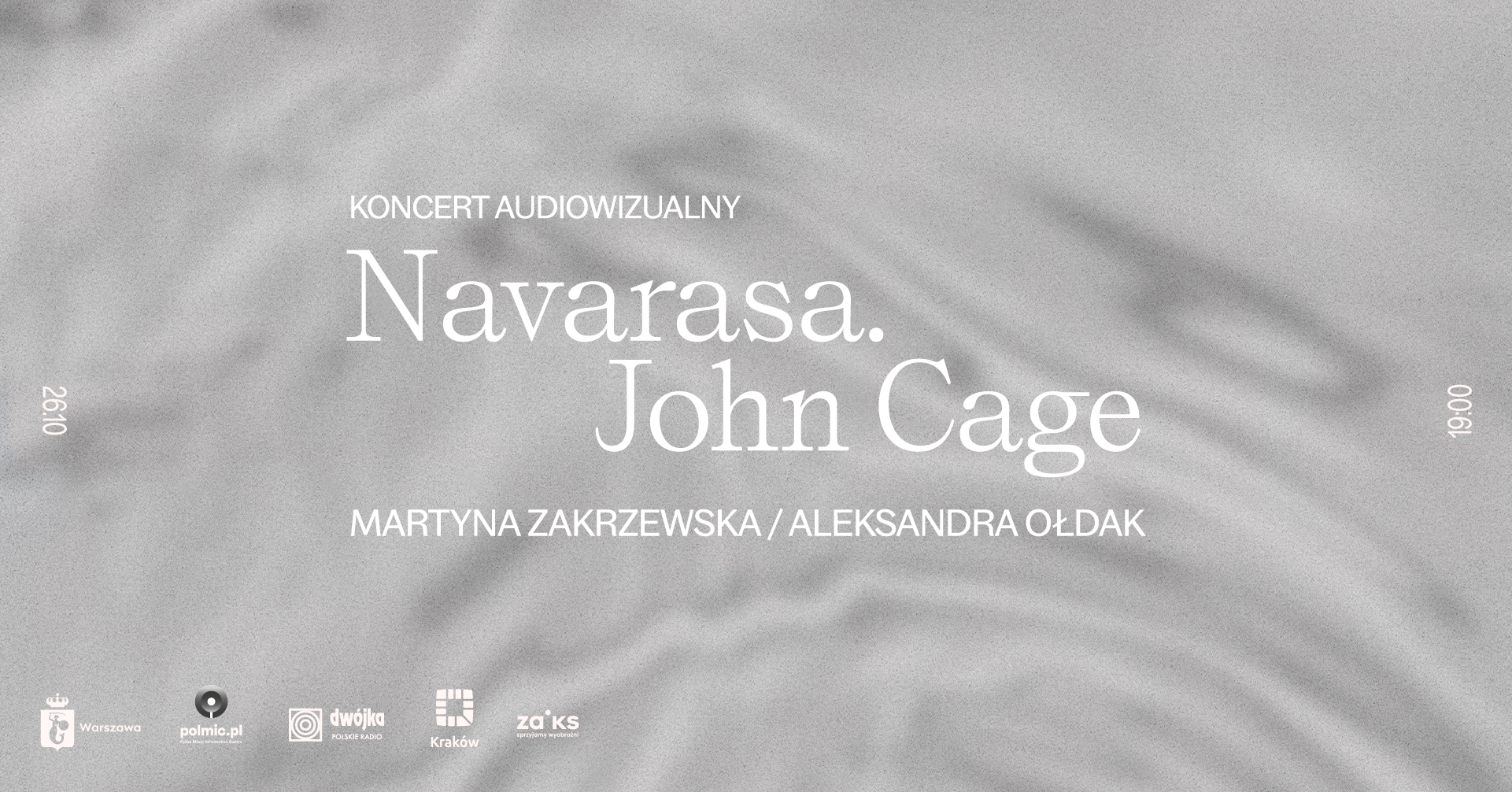
A concert-installation featuring the complete Sonatas and Interludes by John Cage for prepared piano (1946–48). The music draws on the Indian concept of art based on nine emotions: love/sensuality, power/courage, anger/fury/rage, disgust/horror, joy/irony, compassion/sorrow, wonder/delight, fear/dread, and serenity/calm.
The sound of the instrument has been modified by placing nails, screws, pieces of rubber and plastic between the strings. The result is a unique bridge in music history between Western and Eastern art, and an equally unique piano sound.
In the interpretation by Martyna Zakrzewska and Aleksandra Ołdak, music meets image through hybrid visuals combining live-captured video from the performance with 3D renders. The central motif of the three-dimensional animations is a wind simulation — a variable, generative force acting on digital objects like an unregulated impulse. As in Cage’s own concepts, chance and openness of process become compositional strategies. The image does not so much illustrate the sound as function as a parallel, autonomous layer of presence.
The space will be arranged to encourage individual reception and contemplation — visitors may lie on mats, walk around, or sit.
Programme:
John Cage Sonatas and Interludes for prepared piano*
*world premiere
Performers:
Martyna Zakrzewska piano
Production:
Aleksandra Ołdak visuals
programme concept and text:
Aleksandra Ołdak, Martyna Zakrzewska
production: Agata Krystek, Olga Pasek
visual identity: Aleksandra Ołdak
This project is realised with funds from the “Creative Scholarship of the City of Kraków”.
The project received a scholarship from the Creative Fund of the Authors’ Association ZAiKS.
Hashtag Lab Contemporary Music Space is co-funded by the City of Warsaw.
The media patron of the Hashtag Lab Contemporary Music Space is POLMIC.PL.
If you’d like to know more about the artists:
Martyna Zakrzewska is a pianist, soloist and chamber musician devoted to music of the 20th and 21st centuries, a doctor of arts and a teacher. She won a special prize at the X Competition of 20th and 21st Century Music for Young Performers in Radziejowice, and second prize at the 23rd Concorso Luigi Nono. She holds scholarships from the Ministry of Culture and National Heritage and from the Mayor of Kraków. She has performed at the Music University in Graz, WDR, Deutschlandfunk, Universität der Künste in Berlin, the Lviv Philharmonic, the Świętokrzyska Philharmonic, the Witold Lutosławski Studio of Polish Radio, and with the National Polish Radio Symphony Orchestra (NOSPR). She has appeared at festivals including Wien Modern, Acht Brücken, Warszawska Jesień, Łańcuch, Sacrum Profanum, unsound, and TRZY-CZTE-RY. She has given world premieres of works by Zygmunt Krauze, Artur Zagajewski, Cezary Duchnowski, and Joanna Woźny. She has actively participated in impuls Academy, EWCM, Internationale Ferienkurse für Neue Musik, Ostrava Days, Stockhausen-kurse Kürten, and courses run by Ensemble Musikfabrik and Ensemble Modern. Since 2019 she has taught at her home academy in Kraków; since 2022 she has been a lecturer at the Summer Courses in New Music for Performers in Bydgoszcz.
Aleksandra Ołdak (1990) is a visual artist working at the intersection of digital and physical media. Her practice encompasses generative video, 3D renders, objects and installations, focusing on building parametric spaces and exploring the relationships between movement, sound and form. She creates visual frameworks for concerts and performances, experimenting with the integration of image and music. Her work has been presented at Warszawska Jesień, KODY: Festival of Tradition and Musical Avant-Garde in Lublin, NeoArte – Syntezator Sztuk in Gdańsk, Sacrum Profanum in Kraków, DEMO Festival in the Netherlands, and Daegu Contemporary Music Festival in South Korea. She is a graduate of the Faculty of Graphic Arts at the Academy of Fine Arts in Warsaw, where she received a master’s degree from the Department of Conceptual and Intermedia Graphic Arts. In her work she operates in the field of speculative visuality, investigating the boundaries between simulation and matter.