
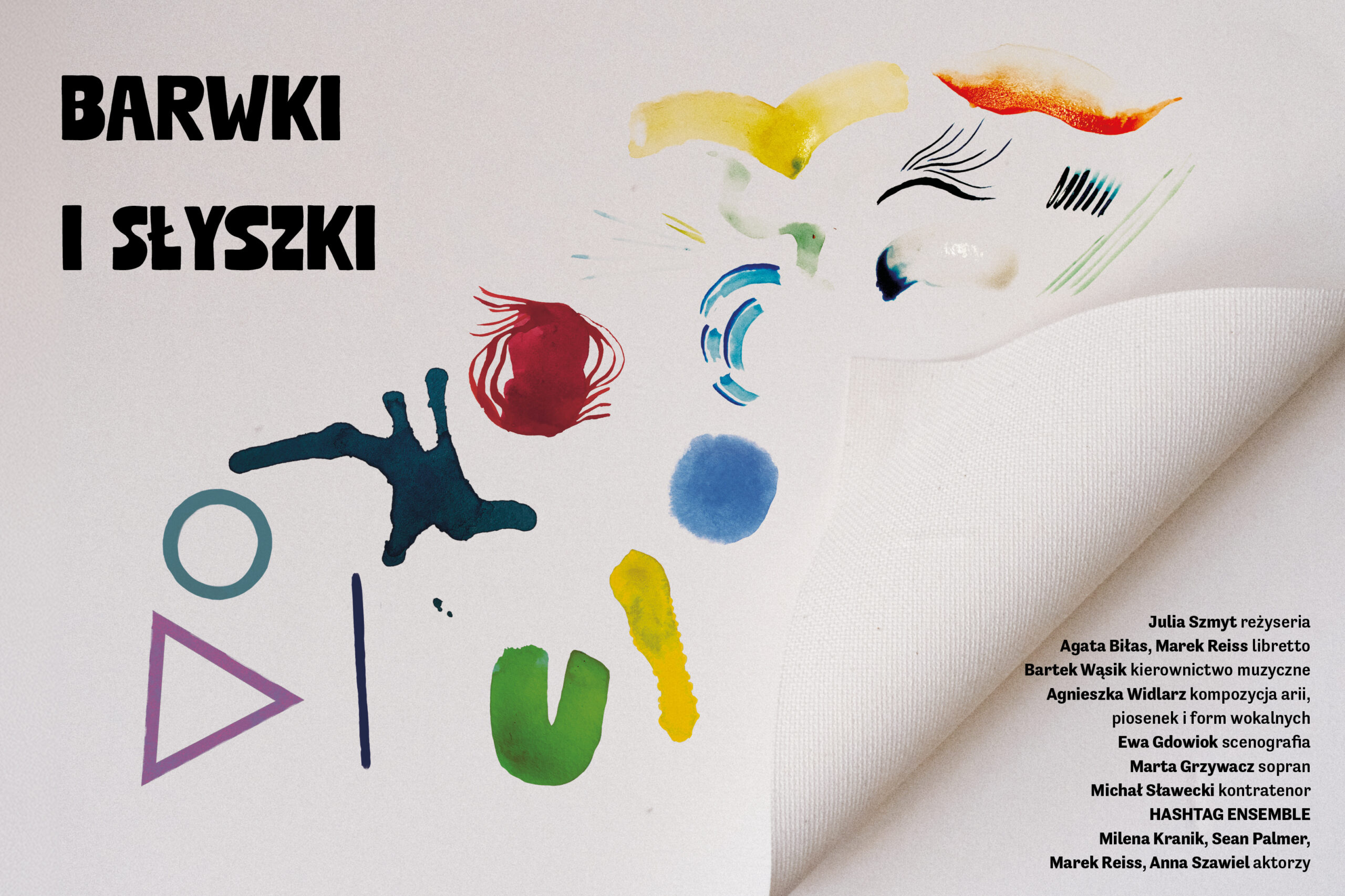
Barwki i Słyszki. Opera binauralna.

Conversations about colours and shapes with visually impaired adults and children were the direct impulse for creating the concept of this opera performance. The knowledge and experience of blind people contained within it, together with the binaural system, will support our auditory perception and attentiveness.
Can you talk about colours with a blind person? You can, and it is well worth doing. From a person with visual impairment you can learn about colours far more than a fully sighted person might know. The experience of realising artistic projects together with visually impaired people is above all about conversations. It was precisely these conversations about colours and shapes with visually impaired adults and children that were the direct impulse for creating the concept of this opera performance. The knowledge and experience of blind people contained within it, together with the binaural system, will support our auditory perception and attentiveness. At the same time, I hope, they will also sensitise us to the world and needs of blind and partially sighted people. A particularly inspiring role in this process is played by Marek Reiss — a guide at the Invisible Exhibition, a wonderful storyteller, and also an actor (which he probably would not have become had he not lost his sight). It is his story — a narrative drawn from his own experience of gradually losing his sight, a story about colours disappearing from his field of vision (literally) one by one — that became the direct impulse for creating this form, largely sonic and musical. And although it is a performance about colours, it is musical for a reason. Timbre is, after all, a category that operates in both the domain of sight and the domain of hearing.
The simultaneous existence of the phenomenon of optical colour and tonal timbre, and the awareness that the loss of sight causes other senses (often hearing) to take over certain perceptual functions, were the inspiration for bringing together the worlds of hearing and seeing through music, visual art and theatre, and for creating the concept of an opera performance that tells — through the interplay of sounds and words — the play of colours, shapes and lights. This is a specific form of audio description, in which not only words, colour names, shape names or relationships between them are used. The aim is a performance that is accessible to blind and partially sighted people while also broadening the knowledge of those with full vision. And at the same time — one that speaks a language close to children.
Barwki i słyszki is a simple story about colours and abstract shapes that one day begin to disappear. Not a cheerful situation — but on the whole, a universal one. And as in life: sadness and gravity often mix with humour, irony, joy and play. As always in such situations, what helps is: perspective, a sense of humour, art and the connections formed. From even the most difficult situation, a way out can be found. Here the world of sounds and music begins to act in a meaningful way. Improvisation and contemporary small vocal forms play a particular role in the musical and sonic layer of the opera: songs, tunes and improvisations. Instrumental interludes are also improvised, as are dialogues that, though originally given a fixed shape, are freely and flexibly spoken and sung by the actors and soloists. And a graphic score becomes one of the protagonists.
Part of the opera’s sonic material will be performed live, and part will be played from a recording. These planes intermingle and interpenetrate, so the listener and audience member should expect a performance with elements of a radio play. Hence the subtitle “binaural opera”. The binaural system (from Latin bi — double, auris — ear) is a technology frequently used in work with blind and partially sighted people as an educational aid. This technology enables the listener to precisely locate in space the acoustic signals that have been recorded, thereby creating the sonic illusion of being in the place where the recording was made. Binaural technology allows for very careful and sensitive management of sound. Thanks to these possibilities, every sound can be heard very precisely and selectively, while at the same time offering the chance for complete focus and the full experience of music and the sonic event.
Dates:
21 September (Saturday) 11:00, 13:00
22 September (Sunday) 11:00, 12:30, 14:00
23 September (Monday) 9:30
24 September (Tuesday) 9:30, 11:00, 13:00
Text: Anna Kierkosz
Performers:
Marta Grzywacz voice
Michał Sławecki voice
Milena Kranik, Sean Palmer, Marek Reiss, Anna Szawiel actors
Hashtag Ensemble:
Marta Piórkowska violin
Krzysztof Kozłowski piano
Oliwier Andruszczenko clarinets
Magdalena Kordylasińska-Pękala percussion
Production:
Bartek Wąsik musical direction
Agnieszka Widlarz composition of arias, songs and vocal forms
Julia Szmyt direction
Ewa Gdowiok set design
Kreshnik Haxhidauti, Ewa Gdowiok, Julia Szmyt multimedia
Agata Bilas Marek Reiss libretto
Damian Pawella lighting direction
Maciej Mulawa recording and sound direction
Anna Kierkosz artistic concept based on the story of Marek Reiss, texts of arias and vocal forms
and
Agata Zakrzewska voice and vocal consultation
Andrzej Życzyński, Zuzanna Gardocka, Julianna Chrzanowska accessibility consultation
Justyna Józefowicz psychological consultation
Kosma Standera sound projection
Partners of the premiere and post-premiere showings of the binaural opera:
Hashtag Lab Contemporary Music Space, Teatr Lalek Guliwer.
Organiser of the accompanying post-premiere showings: Fundacja Muzyka jest dla wszystkich
Post-premiere showings for organised groups were co-financed by the State Fund for the Rehabilitation of Persons with Disabilities PFRON within the National Programme “Sensitive Culture”, and from the funds of the Minister of Culture and National Heritage from the Culture Promotion Fund — a state special-purpose fund, within the “Accessible Culture” programme.
The Hashtag Lab Contemporary Music Space is co-financed by the Capital City of Warsaw.